Coming full circle
Strong and flexible shoulders help you safely reach overhead, carry heavy items, and enjoy such sports as golf, tennis, and pickleball. But we don’t always give our shoulders the attention they need.
“Shoulder mobility and strength are use-it-or-lose-it skills,” says Eric L’Italien, a physical therapist with Harvard-affiliated Spaulding Rehabilitation. “Men tend to focus on other muscle areas and joints, but your shoulders carry much responsibility, and we often don’t value their importance until problems arise.”
Get your copy of Mobility and Independence
|
Mobility and Independence, a Special Health Report from Harvard Medical School, will help you maintain your mobility and safeguard your independence. It will give you recommendations for exercise, diet, preventive care, and lifestyle choices that will keep you stronger and steadier with fewer aches and more stamina. Plus, you’ll get advice for aging in place, adapting and fall-proofing your home, choosing services, and more.
|
|
Working muscles and spine
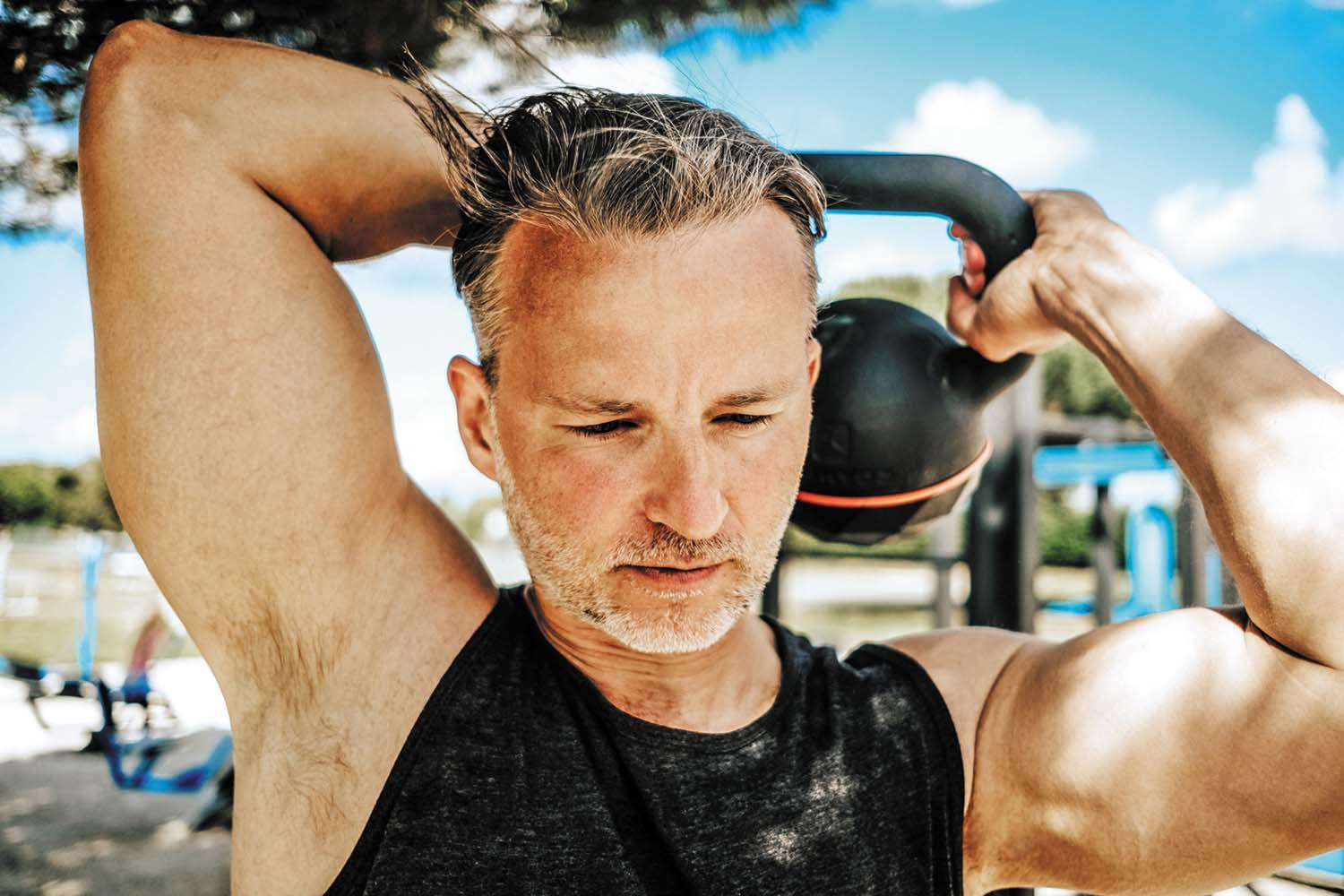
There are many exercises for improving shoulder mobility and strength, but among the best are halos, as they offer multiple benefits. Holding a kettlebell, dumbbell, weight plate, or even a heavy book with both hands, you rotate the weight around your head in a circular motion, as if drawing a halo over your head.
The halo simultaneously targets the shoulder and supports the upper back (the deltoid, trapezius, and rhomboid muscles), as well as engages the forearms and core as you move through the range of motion.
Halos are also good for improving thoracic spine mobility. Your thoracic spine is the middle section of your spine, beginning at the base of your neck and ending at the bottom of your ribcage. Thoracic spine mobility plays a significant role in maintaining a healthy, upright posture.
“Immobility in this area can result in stiffness, neck or lower back pain, decreased range of motion, and poor posture,” says L’Italien.
Here’s how to assess your thoracic spine mobility. Stand in your normal posture and raise one straight arm as high as possible. Now repeat the movement while standing with your back against a wall. “If you have a slumping posture, you won’t be able to raise your arm as high as when standing against the wall,” says L’Italien.
Get a handle on halos
While you can use any kind of weight to perform halos, L’Italien prefers the kettlebell. “It’s often easier and more comfortable to hold because of its handle, and its narrow shape makes it easier to move behind the head,” he says. “But use whatever works best for you, especially if you have a weak grip or suffer from arthritis.” L’Italien also recommends beginning with a five- to 10-pound weight, performing 10 rotations (five clockwise and five counterclockwise),
and then waiting a day to see how your shoulders feel.
“You always want to be careful with shoulders, so it’s best to ease into halos,” he says.
If you feel okay after this test, do 10 rotations in each direction to complete one set and perform two or three sets, resting in between. “As you progress, gradually increase the weight,” says L’Italien.
How to perform halos
- Stand with your feet shoulder-width apart.
- Hold a kettlebell by the handle with both hands, bringing it to chest level.
- Keep your elbows slightly bent and your core engaged. Relax your shoulders.
- Lift the kettlebell above your head, then slowly begin moving the kettlebell in a circular motion around your head, keeping your chest lifted and your back straight.
- Move the kettlebell in a complete circle around your head in a clockwise direction, ensuring it stays close to your head but does not touch it.
- Perform the movement in a smooth and fluid motion.
- Once you’ve completed a full circle, pause for a second, and repeat the movement until you’ve completed up to 10 rotations.
- Repeat in a counterclockwise direction up to 10 times.
|
Take a stance
Besides the standard stance (see “How to perform halos”), there are other stances you can take when doing halos: sitting, standing in a split stance (like in a mini-lunge position), or kneeling on one or two knees.
“Sitting is the easiest for beginners, but as you become more comfortable, performing halos while kneeling can better engage the core,” says L’Italien.
Halos can be incorporated into your regular exercise routine or used as an upper-body warm-up before workouts. Before doing halos, consult your doctor if you’ve had shoulder problems, a previous injury, a shoulder replacement, or any upper back or neck issues.
For more on how to preserve your mobility so you can stay active, buy Mobility and Independence, a Special Health Report from Harvard Medical School.
Image: © Guido Mieth/Getty Images
|